Mold remediation is the cleanup after the fact — the response to what unaddressed water leaves behind. Mold isn’t a random event; it’s biology reacting to moisture, and it almost always traces back to a leak, a flood, or drying that never happened properly. We inspect, contain, remove, and verify mold problems in homes and businesses across Hattiesburg and the Pine Belt, and we fix the moisture source so it doesn’t simply grow back.
Mold Is What Unaddressed Water Leaves Behind
Every mold problem starts with water. When materials stay damp, spores that are always present in the air find what they need to colonize — and under EPA guidance, that can begin within 24–48 hours of water exposure.[1] That’s the whole reason water damage is treated as an emergency: the window to dry a structure before mold takes hold is measured in hours, not days. By the time mold is visible or you can smell it, the growth has usually been underway for a while and often extends into places you can’t see — inside wall cavities, under flooring, behind baseboards.
How to Tell You Have a Mold Problem
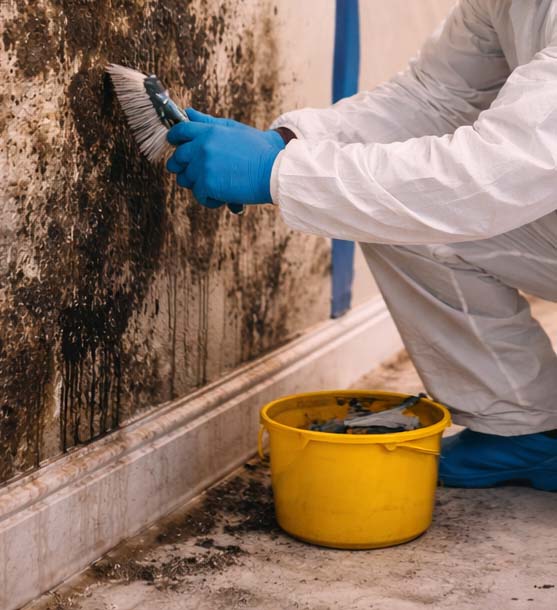
Mold announces itself in a few ways, and the Pine Belt’s heat and humidity give it plenty of opportunity:
- A persistent musty, earthy odor that doesn’t go away with cleaning.
- Visible spotting or discoloration — black, green, or brown — on walls, ceilings, grout, or around windows.
- Worsening indoor symptoms. The EPA notes mold exposure can trigger allergic reactions and irritation, especially for sensitive individuals.[2]
- A recent water history — a leak, flood, or humid, poorly ventilated space.
If you smell it but can’t find it, that’s a reason to inspect, not to ignore it.
Containment, Removal, and Clearance
Remediation is deliberately different from wiping a wall — the goal is to remove mold without spreading it:
- Inspection. Find the moisture source and map the extent, including hidden growth.
- Containment. Isolate the work area so spores disturbed during removal don’t travel to clean parts of the building.
- HEPA air filtration. Scrub airborne spores from the work area throughout the process.
- Removal. Take out mold-damaged porous materials that can’t be cleaned; clean and treat salvageable surfaces.
- Dry and correct the source. Bring moisture back to normal and fix the leak or intrusion that fed the growth.
- Post-remediation verification. Confirm the area is visibly and measurably clear before rebuild.
This approach follows EPA mold remediation guidance for isolating and safely removing growth.[2]
What Drives the Scope of Remediation
No two mold jobs are alike, and the honest scope drivers are physical:
- How long the moisture was present — a slow leak feeding growth for months is a bigger job than a fresh spill.
- How far the growth spread — surface-only versus into wall cavities, HVAC, and framing.
- The materials affected — porous materials usually require removal; hard surfaces can often be cleaned.
- Whether the moisture source is still active — remediation that doesn’t fix the source doesn’t last.
We scope from inspection and moisture readings, document it for your insurer, and correct the cause so the fix holds. Smell mold or found a patch after a water problem? Request an inspection or call — a real person answers, day or night.
Sources
Frequently Asked Questions
Under EPA guidance, mold can begin growing on damp materials within 24–48 hours of water exposure. That's why the response to any water loss is to dry the structure fast — the window to prevent mold is short.
Common signs are a persistent musty odor, visible spotting or discoloration on walls and ceilings, and worsening allergy-type symptoms indoors after a water event. Mold also hides behind walls and under flooring, so what you can smell often means more than what you can see.
No. Wiping surface mold with bleach doesn't address growth inside porous materials or airborne spores, and disturbing a colony without containment can spread it. Proper remediation isolates the area, filters the air, and removes affected material safely.
Inspection to find the moisture source and extent, containment of the work area, HEPA air filtration, removal of mold-damaged porous materials, cleaning and treatment of salvageable surfaces, and a post-remediation check to confirm the area is clear.
Not if the moisture source is fixed. Mold needs water to grow, so lasting remediation always includes finding and correcting the leak, intrusion, or humidity problem that fed it — otherwise it returns.